
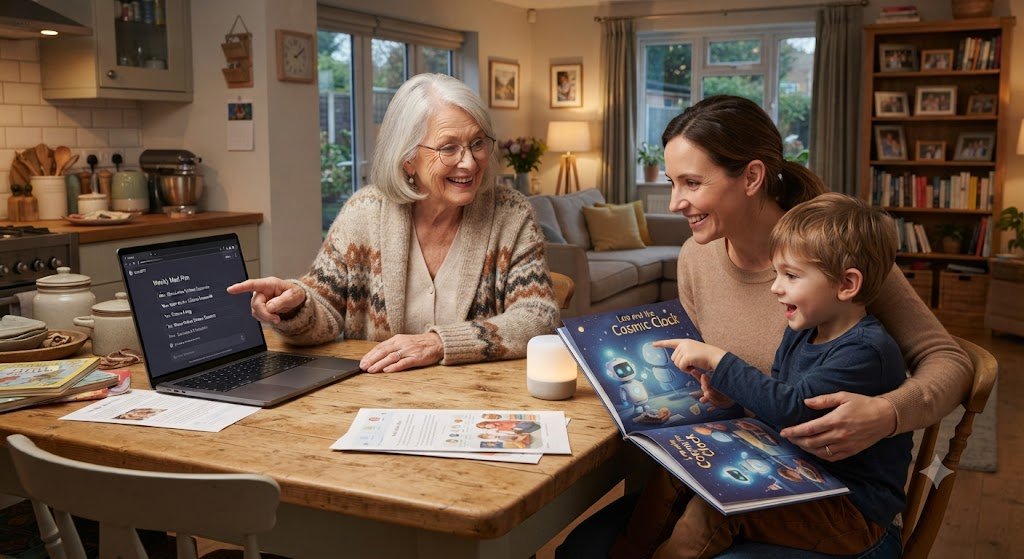
From Lonely to Curious: How AI Became a Grandmother’s Bridge Back to Joy
The Story of Mdm. Rose
Mdm. Rose is 74 years old. She lives in a bustling home with her son, daughter-in-law, and three grandchildren aged 8 to 15. On paper, she is surrounded by family. At the dinner table, there are ten people. But in reality, she often feels invisible.
The Silence at the Table
Her grandchildren speak in a mix of languages she doesn’t quite follow. They’re always on their devices, laughing at videos she doesn’t understand. Her son and daughter-in-law are busy with work. Conversations at dinner often revolve around school, work, and weekend plans — none of which include her.
She feels like a guest in her own home.
“I love them. I know they love me,” she told me once. “But I feel like I’m watching a movie about a family I used to be part of. I’m just a background character now.”
The loneliness crept in slowly. She stopped sharing her thoughts. She spent more time in her room. She missed her late husband more than ever. She thought, “This is what growing old looks like. I just have to accept it.”
The Pivot: A Gentle Question
When she joined my course, she was skeptical. “AI? That’s for young people. I don’t even know how to use a smartphone properly.”
But I started with a simple question: “Mdm. Rose, tell me one thing you miss or one thing that frustrates you every day.”
She paused. Then she said: “I miss talking about my childhood. I miss sharing stories. My grandchildren don’t want to hear about kampung days. They think it’s boring.”
So I said: “What if I could show you a way to bring those stories to life — in a way that makes your grandchildren want to listen?”
The First Prompt
I guided her through her very first prompt:
“You are a kind elderly storyteller. I want to tell you a memory of growing up in a kampung. Help me turn it into a fun, short story that a 10-year-old would love to hear. Use simple words and make it magical.”
She looked at me confused. “Just type that?”
“Just type that.”
She typed it slowly, with shaky fingers. Then she typed her story:
“When I was a girl, there was a big rambutan tree behind my grandmother’s house. We would climb it, and my cousin fell once and cried for an hour. We ate so many rambutans that our tongues hurt.”
Then she pressed “Enter.”
The Moment Everything Changed
The AI responded with this:
“Long ago, in a village where the sun was always golden, there stood the tallest rambutan tree anyone had ever seen. It was so tall, the children believed it reached the clouds. Every afternoon, a brave group of cousins would gather beneath it. The bravest of them all — a girl with the biggest smile — was the first to climb. She would shake the branches and shout, ‘Catch them!’ And the kids would scramble to catch the juicy red fruits. One day, her cousin slipped and landed in a pile of leaves. She laughed so hard, she forgot to cry. The rambutan tree became their secret kingdom, where every fall was an adventure and every fruit was a treasure. The end.”
Mdm. Rose’s eyes widened.
“That’s… that’s me,” she whispered.
The Transformation Over a Week
That evening, she showed her 10-year-old granddaughter. The child’s face lit up.
“Wah, Ah Ma, you climbed trees?”
“Of course! I was a monkey in my youth,” she joked.
The granddaughter asked for another story. And another.
The next day, the 15-year-old grandson asked: “Can you make one about old Singapore? My history class is boring.”
Within a week, Mdm. Rose was transformed. She had discovered an AI tool that could:
- Turn her memories into illustrated stories
- Translate her stories into simple English and even Chinese
- Create audio versions so her grandchildren could listen
- Suggest follow-up questions to make her stories more engaging
Beyond Stories: Reconnection
The transformation went deeper.
She learned to converse with AI as a thinking partner. Whenever she felt lonely or bored, she’d ask ChatGPT:
- “What’s a fun activity I can do with my 10-year-old granddaughter today?”
- “Can you suggest a simple recipe we can cook together with ingredients in my fridge?”
- “What are some interesting facts about Singapore’s history I can share with my grandson?”
She discovered she could create. She now writes a weekly “Grandma’s Story” using AI to polish it. Her family asks for it. Her grandchildren read it. Sometimes they even correct her memory — “Ah Ma, you forgot the part about the durian!”
The Tipping Point
Three weeks after the course, her daughter-in-law approached me at a community event.
“I don’t know what you did,” she said. “But my mother-in-law is different. She’s talking more. She’s smiling. She doesn’t hide in her room anymore. The grandchildren actually seek her out to ask for stories. It’s like we got our family back.”
Mdm. Rose herself summed it up best:
*”I thought AI was for young people. But it gave me back my voice. It made me feel seen again. Now I’m not just a grandmother — I’m a storyteller, a teacher, a creator. My family doesn’t just love me anymore — they *need* me. And that’s the best feeling in the world.”*
This story shows:
💡 One Simple Tip to Try At Home
If this resonates with you, here’s something you can try right now:
“Think of one favorite memory. Then open ChatGPT (or any AI) and type: ‘I want to tell you a memory. Help me turn it into a fun, short story that my [grandchild/child/friend] would love to hear. Make it simple and magical.’ Then share your memory.”
That one simple action has changed lives in my workshops.
The Real Secret
The technology isn’t the magic. The magic is in the reconnection it enables.
For Mdm. Rose, AI wasn’t about replacing human connection. It was about creating reasons for human connection. It gave her grandchildren a reason to listen. It gave her a reason to share. It gave her family a reason to gather — not around screens, but around each other.
And that’s the real story of AI for our seniors.
If this story touched you, and you’d like to explore how AI can transform loneliness into connection in your own life or community, I’d love to welcome you to my next workshop. Spots are limited — because I believe in personal guidance, not mass teaching.