
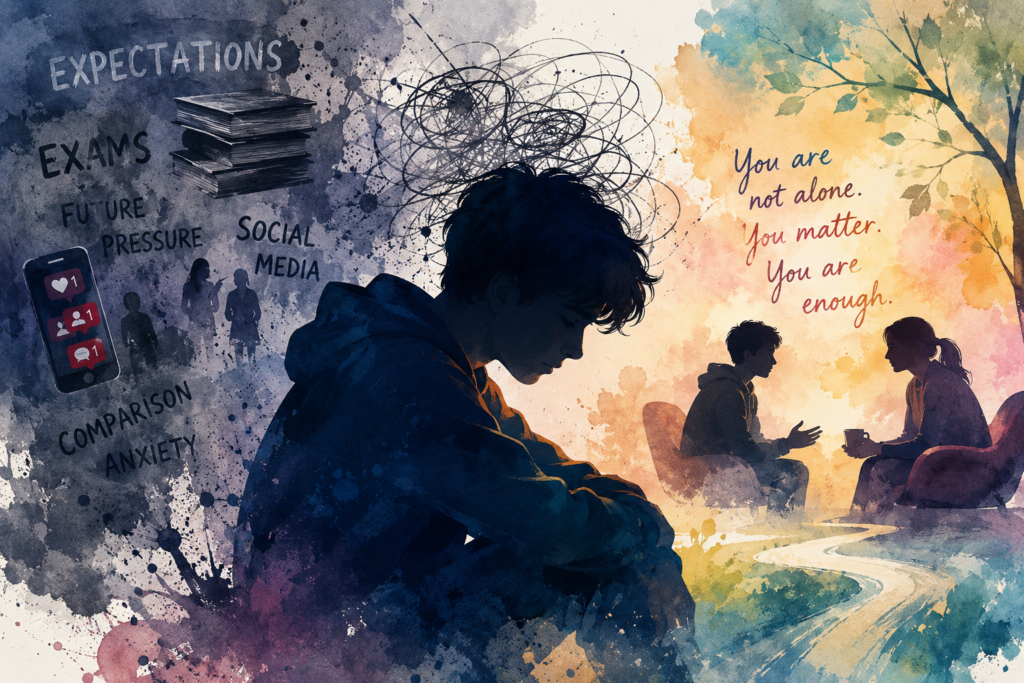
When Young Hearts Feel Heavy: Understanding Teen Stress in Today's World
There was a time when being a teenager meant worrying about homework, friendships and perhaps what career to pursue.
Today’s teenagers carry much more.
School pressure.
Social media comparisons.
Fear of disappointing parents.
Concerns about the future.
Body image issues.
Friendship dramas.
Financial worries at home.
The pressure to appear happy even when they are struggling inside.
Many teenagers today are not simply growing up.
They are growing up under a spotlight.
The Hidden Stress That Parents Often Do Not See
Many parents provide food, shelter, education and opportunities because they love their children deeply.
Yet sometimes a teenager’s greatest need is much simpler.
To feel heard.
To feel understood.
To feel safe enough to say:
“I am struggling.”
Unfortunately, many teenagers fear being judged, criticised or misunderstood.
So they remain silent.
Instead of saying:
“I feel overwhelmed.”
They say:
“I’m tired.”
Instead of saying:
“I’m scared about my future.”
They say:
“I’m okay.”
Instead of saying:
“I need help.”
They close their bedroom door.
Why Teenagers Keep Things To Themselves
Many young people worry that sharing their feelings will:
• Burden their parents.
• Lead to lectures instead of listening.
• Cause disappointment.
• Result in restrictions or punishment.
Some feel nobody will understand them anyway.
So they carry their worries alone.
Sometimes for months.
Sometimes for years.
Signs That A Teenager May Be Under Stress
Every teenager is different, but common signs include:
• Becoming unusually quiet or withdrawn.
• Spending excessive time alone.
• Irritability or sudden anger.
• Changes in sleeping habits.
• Loss of interest in favourite activities.
• Difficulty concentrating.
• Sudden drop in academic performance.
• Increased screen time and social isolation.
• Frequent headaches or stomach discomfort.
Stress does not always look like sadness.
Sometimes it looks like silence.
What Teenagers Need Most
Young people rarely expect parents to solve every problem.
Often they simply want someone who will:
Listen without interrupting.
Avoid immediate judgement.
Offer support instead of solutions.
Allow them to express emotions safely.
Sometimes the most powerful words a parent can say are:
“Tell me more.”
And:
“I am here for you.”
The Power Of Safe Conversations
Healing often begins with conversation.
Not lectures.
Not criticism.
Not comparisons.
Conversation.
A simple cup of coffee.
A quiet walk.
A shared meal.
A safe space where young people know they will be heard without being judged.
When teenagers feel emotionally safe, they begin to open up.
And when they open up, families reconnect.
Parents Are Not The Enemy
Many teenagers believe their parents cannot understand modern pressures.
Many parents believe their children have become distant.
The truth is usually much simpler.
Both sides care deeply.
Both sides are worried.
Both sides are waiting for the other to speak first.
Sometimes all that is needed is a bridge.
You Are Not Alone
To every teenager reading this:
Feeling stressed does not mean you are weak.
Feeling overwhelmed does not mean you are failing.
Asking for help does not mean you are broken.
Life can feel confusing sometimes.
That is part of being human.
Speak to someone you trust.
A parent.
A teacher.
A relative.
A mentor.
A counsellor.
A friend.
You do not have to carry everything alone.
Conversations Can Change Lives
At Coffee Talk, we believe healing often begins with something very simple:
Being heard.
Through conversations, music, creativity and shared experiences, young people discover that many others are facing similar struggles.
Sometimes the greatest gift we can offer another person is not advice.
It is our attention.
Because when someone feels truly heard, hope often follows